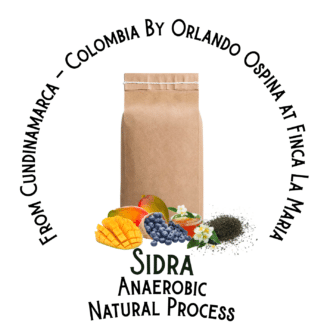
Sidra Coffee Finca La Maria
Price range: $32.00 through $343.00
We taste Blueberry, Lilac, Jasmine Tea, & Grapefruit. This rare coffee is harmonious but intricate. It is bursting with flavor. Funky, fruity, and a thirst-quenching tropical acidity.
Best Colombian Coffee. Sidra Coffee. Nestor Lasso. Finca el Diviso
Sidra Coffee: Your new favorite pour-over?
Fruity. Floral. Dynamic. Clean. This Colombian bean is one of our all-time favorites. Big, clear, and juicy tropical fruit flavors like ripe mango and papaya are spread broadly across the well-structured palate. We love waking up to the diverse floral aromas of this coffee in the V60 or bigger batches in the Chemex with family and friends. Jasmine is up front and green tea-like. Geranium, lilac, and violet too.
Coarser grinds brought out jasmine green tea, pink peppercorn, and lilac in aroma and in the cup. Finer ground brews were full of sweeter notes like watermelon, guava, and rooibos tea. Lots of fun summer fruits and hints of herby citrus in the finish make this coffee a wild ride worth taking.
Gesha Coffee Variety
About the Dry/Natural Processing
This micro-lot is an experimental low-oxygen dry or natural process coffee.
- Firstly, the coffee was harvested through selective hand-picking of ripe cherries.
- Secondly, after harvest, the cherries underwent water flotation to remove floaters and defective fruit, followed by a manual re-sorting process to eliminate any remaining dried, overripe, or underripe cherries.
- Thirdly, The selected cherries were then placed in sealed tanks for anaerobic fermentation for 72–96 hours, with fermentation time adjusted according to environmental conditions and fermentation development.
- Finally, once fermentation was complete, the coffee was drained and dried gradually in stages, with resting periods between drying sessions to ensure a stable, uniform drying process. After reaching the target moisture content, the coffee was packed in GrainPro bags and placed in jute sacks to preserve its quality and stability.
About the Farmers


Agronomist Orlando Ospina specializes in non-traditional types of coffee processing. He works diligently with his partner Emilcen Sanchez towards family farm ownership. Since 2016 Lohas Beans has leased a farm to them and in 2019 assisted them in acquiring a home nearby. Certainly, Rigby Roastery owners Brigette and Naiman are immensely inspired by their dream.
Orlando and Emilcen exercise great fervor, warmth and zeal in their pursuit to produce the best specialty coffee in Colombia. In 2017, they were participants in the Cup of Excellence. On their first year of production, in a highly competitive country like Colombia, they achieved second place!
They export 98% of their production and only sell 2% domestically under the Café Lohas brand. It’s in high demand! Many top baristas select Orlando and Emilcen’s crops to compete in coffee championships around the world. We are elated to share this special coffee with you. It is a perfect example of everything they have accomplished.
They face a difficult path to success with confidence and in great shape to continue to improve and strengthen their already exemplary Sidra coffee beans year after year. The proof is in the cup.
About the Terroir
La Mesa means “the table” in Spanish. It is located on a 2.5² mile plateau over the Eastern Cordillera, the widest of the 3 branches of the Colombian Andes mountain range. A dense fog is a common occurrence here as warm air rises from the Magdalena Valley. This fog collides with cooler air from the capitol city of Bagota. This micro-climate cloud forest is an average 75F year round.
Two volcanoes, the Nevada del Tolima and Ruiz, can be seen in the distance on a clear day. All of these things create the perfect place to grow specialty coffee varietals. These are often sensitive plants that doesn’t fruit as much as most coffee plants do.
Sidra Coffee Beans
Sidra is a distinctive coffee variety known for its complex and expressive cup profile. It is often characterized by tropical fruit, floral notes such as lavender, rose and jasmine, bright acidity, and a silky mouthfeel. Its combination of sweetness, aromatic intensity and complexity contributes to a distinctive and elegant cup profile.
This unique varietal of coffee is a fun fan favorite. The meticulously performed processing makes it fruity and reminiscent of apple cider. Thus, the name, sidra. Complex, bright, juicy, chuggable. Pour overs are sweet and memorable. We taste red currant, blackberry, grapefruit, sangria, and black cherry.
The smell while brewing sweet and floral. As a single origin espresso we tasted all of the above as well as hints of hops and sparkling wine. It’s always one of the best dry process Colombian coffees we offer each year.
What is Sidra Coffee?


The Sidra varietal is a mysterious one. It was initially thought to be an intraspecific hybrid of Bourbon and Typica. However, according to recent studies performed by the World Coffee Research Institute it has no clearly identifiable genetic identity. Some say it is derived from Ethiopian landrace varietals.
Because there is no singular source to reference many different crops may be identified as Sidra. Don Olger Rogel was likely the first person to introduce the Sidra varietal (sometimes referred to as Bourbon Sidra or Sydra) to the world via the specialty coffee market in Ecuador.
It is widely reported that the varietal was developed at the Nestlé breeding facility in Ecuador. It was said to have been given to farmers for free in order to collect feedback from them. As far as we know, that is unverified and the Nestlé facility has since closed. One of the first plantations to commercially grow Sidra was La Palma y El Tucan in Cundinamarca Colombia.
Between 2012 and 2015 they planted over 6000 plants as the varietal became popular in specialty coffee circles. Cole Torode used their natural Sidra to place 3rd in the world Barista Championships in 2019.
As a roaster, the easiest way to verify a Sidra coffee is by the cup quality and flavor. Certainly, it helps to acquire the coffee from an accredited farm with a history of producing the variety. Furthermore, the beans tend to be longer and pointier than other aribica coffees.
In the field the coffee trees grow up to four meters tall. The trunks are thick and heartier than other coffee trees. The cherries are clustered together densely along the branches. They have dark green leaves and long flowers that have five petals on them. It is a high yielding plant that needs shade to grow.